24 Aug Art and Fear and the Third AI Risk
25 August 2026
By David Allen, Development for Conservation
Reclaim your art today.
I attended the local AFP luncheon here in Asheville the other day. I always pay attention to the monthly topics, and I go to the luncheons when the topic is relevant for me and I happen to be in town – maybe once a year. I have an on-again-off-again relationship with AFP. I’m not really motivated to be more involved. The average tenure for a fundraising professional is about 20 months. It’s a huge problem on so many levels. And I’m not always convinced that AFP is interested in addressing it. There aren’t any career ladders I’m still in the process of climbing.
Regardless, this month’s program WAS interesting and relevant, and I really enjoyed being there.
The speaker listed the same two AI risks that everyone else does – data security and errant communications. But he spent more time on a third risk. I agree with him, that this third risk is harder to see and needs to be discussed more.
He set it up by talking about a social science experiment described in a book called Art and Fear. For the record, I have not read the book. I am ordering the book and will read it when it gets here. I’ll let you know.
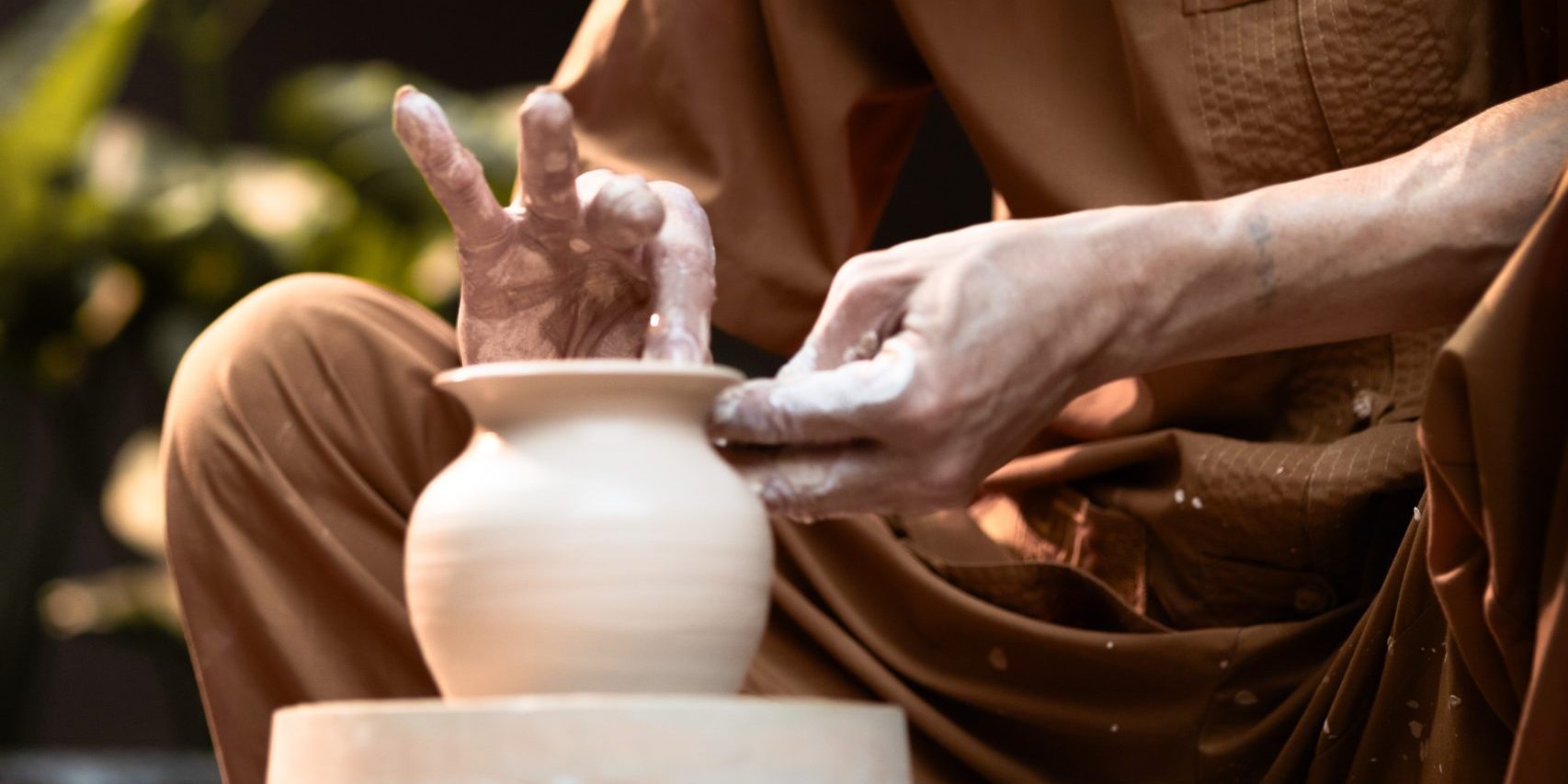
The experiment involved two groups of people who were each given the task of making clay pots that matched a model. They were both given the same amount of time to complete the task. The first group was asked to create as many pots as possible and were “graded” on how many they produced. The second group was asked to produce a “perfect” pot and were graded on how closely they produced a pot that matched the model.
Which group produced pots closest to the model?
The first group.
The book is about making art in a more classic sense, but taken in a larger context, it’s about honing any skill.
Everyone has their own art.
What is your art? In other words, what skills have you developed by doing something over and over? Trying, failing, even face-planting, trying again, refining, compromising to get it done, honing, developing essential muscle memory, and eventually realizing that Heck – I’m pretty good at this.
And how much of this do we risk losing because AI can do it “better” in a small fraction of the time?
The list of skills we are not honing (because we’re afraid) is already long and complicated. Empathetic listening, eye contact, helping new people feel comfortable, making phone calls, facilitating table conversation, speaking in public, offering a toast – technology will never help with these, despite those cute commercials showing AI reminding you of how you know someone who seems to know you.
Mark Phillips has written that AI is more likely to reinforce all of our bad fundraising habits than it is to help us prioritize good ones. He’s probably right.
But let’s take three more likely scenarios: writing a grant proposal for a private family foundation, writing an appeal letter from a story, and writing a thank you letter for an extraordinary gift.
In each case, AI will be very capable of producing very good results. Maybe even 75% good. And I’m sure you are capable of taking it from there – trimming, toning, massaging until the language is just right. You’ve been doing this for decades, and your intuition is finely tuned to what the recipient or audience will respond to emotionally. Moreover, you care how they receive it. You care about what they think and how they perceive the giving decision that they are considering or that they have made.
So, it takes you about 30 minutes to take it from 75% good to 95% great.
You’re still driving the bus. All is good, right?
My AFP speaker said “not so fast”, and I agree. Because the skills it takes to get from 0 to 75% are still skills. They are your art. If you don’t use them, they erode. And if you never do this work enough to develop them in the first place …
Now who’s driving?
Toward the end, the speaker returned to the second risk – that everything AI produces should be reviewed, edited, and refined before sending it out. Taking the products from 75%-95%. And he pointed out that you are able to review such material precisely BECAUSE you have honed those skills yourself. To bring in yet another metaphor, you’ve done the long division and feel comfortable skipping some of the steps (or using a calculator).
If your skills are eroded, or if you never develop them in the first place, how will you tell if the AI products are adequate?
Now who’s driving?
Now who’s art is it?
I’ve been jumping up and down about soft skills for many years – not related to AI specifically, but rather to technology more generally. We used to spend more time building relationships with people over coffee and lunch. Empathetic listening, eye contact, helping new people feel comfortable, making phone calls, facilitating table conversation, speaking in public, offering a toast. Now we are reluctant even to talk to people on the phone.
We used to get great results by putting seed packets and maple leaves inside appeal letters. Now we embed photos.
It’s not the same.
And we aren’t talking enough about what we’re losing. We’ve even begun to accept 50% renewal as the new normal.
Who’s art is that?
Cheers, and have a great week.
-da
PS: Your comments on these posts are welcomed and warmly requested. If you have not posted a comment before, or if you are using a new email address, please know that there may be a delay in seeing your posted comment. That’s my SPAM defense at work. I approve all comments as soon as I am able during the day.
Photo by Mr. Ha courtesy of Pixabay.
Charles LaFond
Posted at 18:13h, 01 SeptemberAs a potter, I love the image. As a fundraiser the article was nicely crafted! Thank you. Charles
Sally Zaino
Posted at 15:10h, 26 AugustThis post relates so much to the importance of the human touch to fund-raising but also so much to the need to continue to work on your skills as a writer. Great post, thank you.
David Allen
Posted at 11:36h, 28 AugustThanks Sally. The work is the teacher. Take away the work, and you take away how we learn.
Alex Kauffman
Posted at 11:25h, 25 AugustLove this, particularly being a musician (artist myself and understanding the value of PRACTICING). I like the point you make about the skills we develop to get to that 70% product. The creation, the brainstorming, etc and how if we don’t practice or do it regularly we will lose the skill set. I would add that the skill set of taking an AI generated product form 70%-95% is also equally important. It’s a new skill that we all are learning. How do we use AI for creative pursuits. So maybe the answer is also BOTH. Spend time learning skills and honing skills to get an AI started project from 70% good to 90% good and then also….. Spend time manually getting your product (Appeal Letter, grant, etc…) from 0%-70%.
Christopher Ott
Posted at 09:16h, 25 AugustGood post. Thank you. I had recently been thinking along similar lines: that A.I. is supposed to relieve us from doing things that are often enjoyable.
It’s interesting too that you used a driving metaphor. Could overreliance on A.I. parallel overreliance on cars, losing our ability to do things without them?
David Allen
Posted at 06:52h, 28 AugustAbsolutely. Thanks for the comment!